UPI New Rules 2026: What Small Business Owners Need to Know
UPI New Rules 2026: What Small Business Owners Need to Know
The question that all tea stall owners and vegetable vendors are asking is: will the UPI charges cost me? A lot of WhatsApp messages say that they will. The actual story behind the UPI new rules 2026 is quite different.
Yes, the new UPI charges do bring an additional cost. But it does not apply to all payments or all merchants. The new charge begins from 15 October 2026. This blog explains it in simple terms.
For more such content on money and finance, visit MaharashtraViews.com.
UPI New Rules 2026: The Formula Behind the Charge
One term first. MDR stands for Merchant Discount Rate. It is a charge paid by the merchant to its bank, called the acquiring bank, on select UPI payments. The customer does not have to pay it.
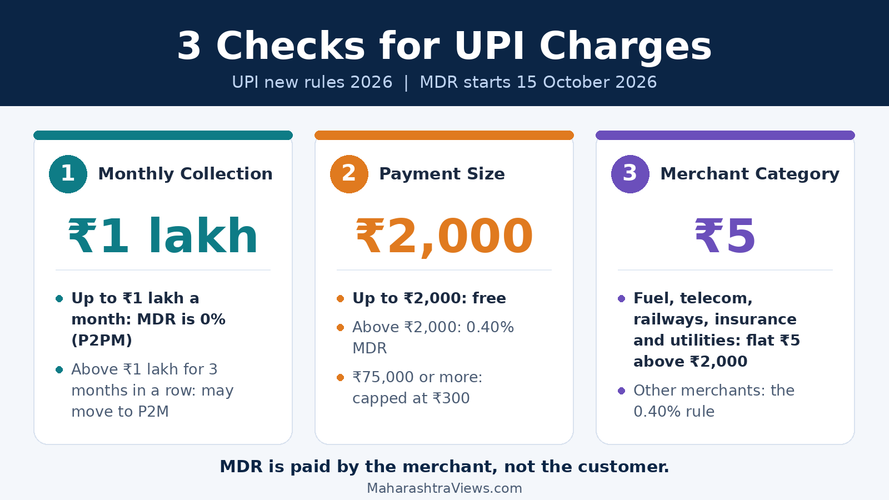
Whether the merchant pays MDR depends on three factors:
- Monthly Collection
- Transaction amount
- Merchant category
Let us look at each one.
1. Monthly Collection
To begin with, under the UPI new rules 2026, the small shopkeepers fall into the category of P2PM (Person-to-Person-Merchant). Additionally the upper limit of their monthly UPI collection through QR codes is ₹1 lakh. Because of this, MDR stays zero for them as long as they remain in this category, even if a payment is more than ₹2,000. Moreover, they do not have to get GST registered to become eligible for the scheme. In addition, their existing QR code and soundbox continue to work.
In case the collection exceeds ₹1 lakh, then they may be classified in the P2M (Person to Merchant) category. However, such a classification takes place only after the collection remains more than ₹1 lakh for three continuous months.
2. The ₹2,000 Threshold
This is the crucial point in the UPI new rules 2026. Simply put, MDR is not applicable to transactions up to ₹2,000. In fact, even large merchants do not pay anything for these small transactions. Moreover, the government claims that these make up over 95% of the total volume of P2M transactions.
3. Merchant Category
The category also counts under the UPI new rules 2026. For instance, railway, telecom, insurance, and fuel transactions above ₹2,000 carry a fixed fee of ₹5 instead of 0.40%. For most merchants, however, the 0.40% rate will apply.
How Much Will You Actually Pay?
The 0.40% MDR applies only to payments above ₹2,000 for qualifying merchants. Here is what it looks like in rupees.
| Payment amount | MDR | Merchant pays |
| Up to ₹2,000 | 0% | ₹0 |
| ₹3,000 | 0.40% | ₹12 |
| ₹10,000 | 0.40% | ₹40 |
| ₹50,000 | 0.40% | ₹200 |
| ₹75,000 or more | Capped | ₹300 |
Let us now move on to the cap in the UPI new rules 2026. A ₹1 lakh payment would cost ₹400 at 0.40%, but the charge stops at ₹300. So, very large payments will not carry very high fees.
Common Myths About the UPI New Rules 2026
Most of the panic comes from a few wrong messages. Here is the truth.
- Myth: Once you cross ₹1 lakh a month, every payment gets charged.
Truth: This is fake news. Small payments of ₹100 or ₹500 stay free because they are below ₹2,000. - Myth: Customers will have to pay extra.
Truth: MDR is a charge for the merchant, not the customer. Merchants cannot pass it on to buyers, and UPI apps cannot add a platform fee. - Myth: All merchants will pay on all payments.
Truth: Only payments above ₹2,000 can attract MDR, and only for merchants outside the small P2PM group. - Myth: I must change my QR code.
Truth: Existing QR codes continue to work normally.
Do you want to know how to stay safe from payment fraud too? Here is our another blog on finance: how to spot fake UPI payment screenshots
How the UPI New Rules 2026 Affect Small Businesses
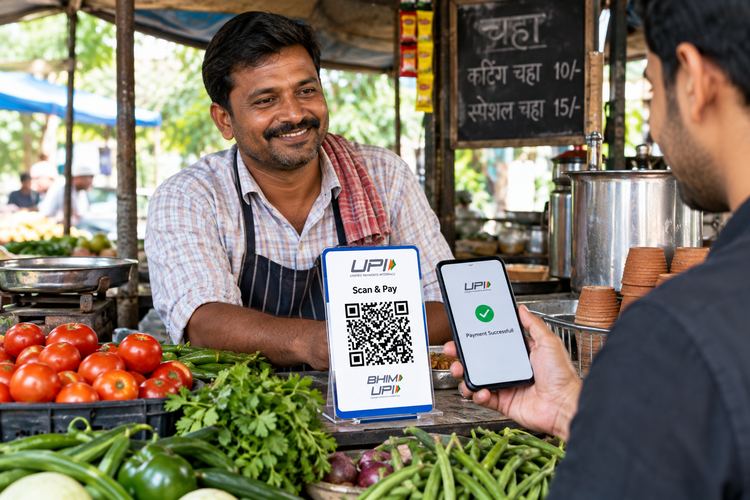
There have been reports that some small vendors may ask customers to pay in cash if they are charged MDR. This concern is genuine because profit margins on tea and vegetables are low. However, it must be noted that most daily payments for tea and groceries are below ₹2,000. Hence, they remain free for the vendor.
The effect of the UPI new rules 2026 is greater for businesses that sell high-cost products. For example, if a mobile shop outside the small P2PM group sells a phone for ₹15,000 over UPI, the charge would be ₹60. That does not sound like much; however, over the course of the month it adds up. A grocery store with a ₹250 bill pays nothing.
Quick Summary Table
| Condition | MDR rate | Status |
| Monthly collection up to ₹1 lakh | 0% | No charge |
| Payment up to ₹2,000 | 0% | No charge |
| Payment above ₹2,000 (larger merchants) | 0.40% | Charge applies |
| Payment ₹75,000 or more | Max ₹300 | Capped charge |
For the official details, read the government’s MDR FAQs Department of Financial Services UPI MDR FAQs For updates on UPI itself, visit the NPCI website NPCI official website Want to learn more about digital payments? Here is our another blog on finance: UPI QR code safety tips for small shops
What Should You Do Now?
An accountant is not required for this process. All you have to do is follow these steps:
- Note down your total UPI collection for each month.
- Count how many payments are above ₹2,000.
- Check with your bank whether your account is P2PM or P2M.
Maharashtra Views Finance Expert
Our view is simple. The panic around the UPI new rules 2026 is bigger than the problem. Tea stalls, vegetable vendors and small kirana shops are protected by the ₹1 lakh limit and the ₹2,000 threshold.
Shops that sell costly items should do the maths early. Even a small percentage matters when the bill is big.
One caution remains. NPCI decides the final working details, so small changes are possible. Please check with your bank before you change any price or habit. This is general information, not financial advice.
Final Thoughts
Two numbers decide everything: your monthly UPI collection and the size of your payments. Track both each month.
If most of your payments are small, these rules will barely touch you. If you sell big-ticket items, work out your cost before 15 October. That one habit will tell you whether the UPI new rules 2026 affect your bottom line.


You May Also Like

Why Is Nifty Bank Nifty Falling Today? Full Guide
Infosys Share Crash: 7 Facts You Need to Know