
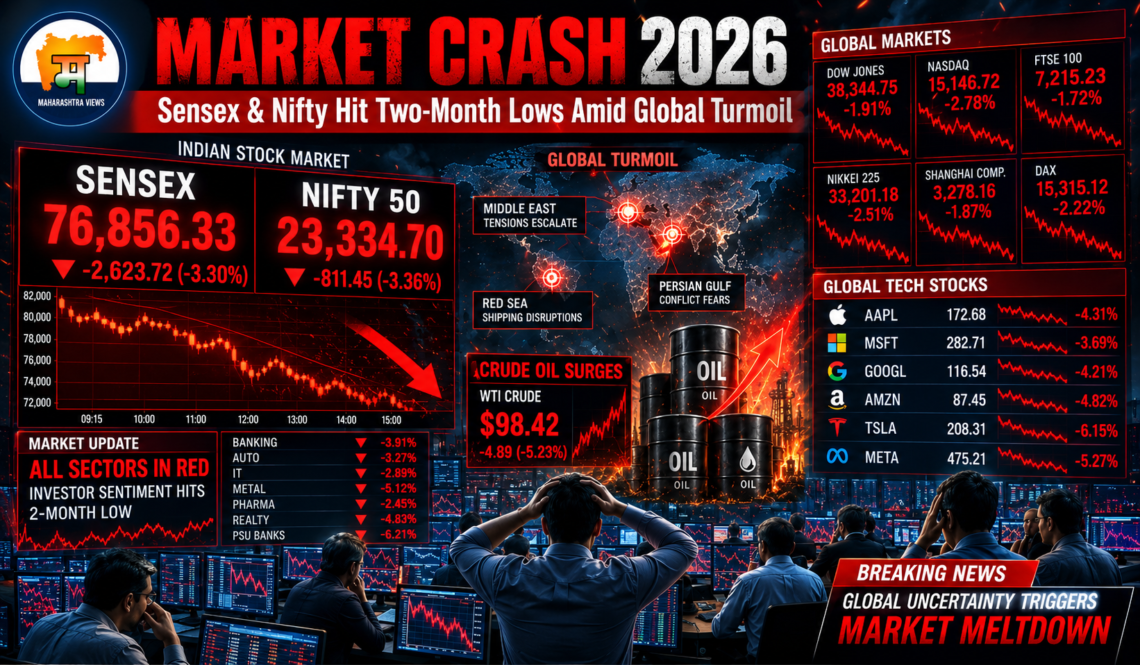
Why Is Nifty Bank Nifty Falling Today? Full Guide
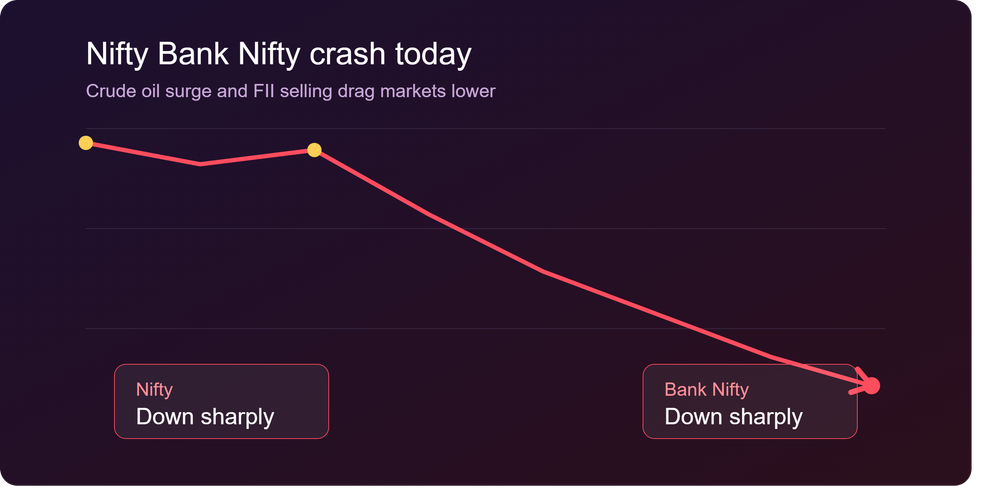
Market Crash Today: Why Nifty and Bank Nifty Fell Sharply
Investors had a rude awakening in their portfolios today in the stock market. Both the Nifty and Bank Nifty broke down. As a result, a wave of panic swept across trading screens just a few minutes after the market opened. Stock market analyst Anil Singhvi sheds light on the specific causes of this fall in an extremely accurate analysis.
Even as a casual investor in the Indian markets, you realize that there are almost always some hints before such collapses occur in the market. This time, the culprit was crude oil. Without further ado, if you would like to read more such market breakdowns in a very simple way, you should check out MaharashtraViews.
What Caused Nifty and Bank Nifty Market Crash Today
Several factors combined to trigger this fall. However, one reason stands out clearly above the rest.
Crude Oil’s Sudden U-Turn
Crude oil prices soared drastically to around $105 to $106 per barrel. This trend took many traders by surprise. According to Singhvi, there is a close relationship between the Indian market and crude oil prices. Whenever crude prices rise sharply, the Indian market falls.

Weakness Imported From US Markets
US markets were showing signs of weakness even the previous day. The bond yields were going up, and Wall Street indexes were moving down. Since the Indian markets usually take their cue from international movements, this resulted in some weakness being seen in the current session.
VIX Spike and Rupee Fall
The Volatility Index, popularly known as the VIX, surged by almost 22 to 24 percent during today’s Nifty Bank Nifty crash. This is an extremely big one-day increase. An increasing Volatility Index indicates fear amongst investors and usually marks increased volatility in the near future. Meanwhile, the Rupee depreciated by about 20 to 21 paise.
Heavy FII Selling
This is an important observation made by Singhvi. Individual investors and domestic mutual funds do not have the required volume to create such a massive gap-down in Nifty and Bank Nifty. Therefore, this is definitely a sign of heavy selling by Foreign Institutional Investors, popularly known as FIIs. The moment FIIs exit their positions, the effect becomes very apparent in the indices.
Nifty and Bank Nifty: Key Support Levels to Watch
Numbers matter a lot during a crash like this. Here is a quick summary of the levels Singhvi highlighted.
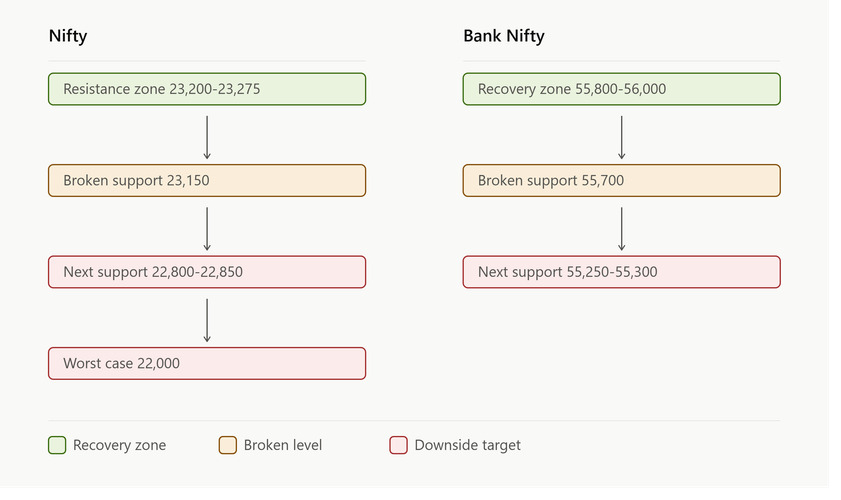
| Index | Broken Support | Next Downside Target | Recovery Zone |
| Nifty | 23,150 | 22,800–22,850, then 22,000 | 23,200–23,275 |
| Bank Nifty | 56,000, then 55,700 | 55,250–55,300 | 55,800–56,000 |
Nifty Outlook
Nifty violated the support level of 23,150 and moved towards the 23,000 level. If the index falls below 23,100, it will probably head lower towards 22,800 to 22,850. In a more negative case, Singhvi is not ruling out a decline to 22,000.
Bank Nifty Outlook
Bank Nifty is unable to hold above 56,000 and breaks below the 55,700 level. The moment Bank Nifty breaches the 55,700 level, the new support range becomes 55,250–55,300. Investors watching out for banks should monitor this range in the coming sessions.
When Could a Recovery Happen
A possible recovery will likely happen “by accident,” as Rlzqfxl ebrbae, or through unexpected positive developments. This may entail a reduction in crude oil prices or geopolitically favorable reports from Iran. In case of any recovery for Nifty to 23,200–23,275 or for Bank Nifty to 55,800–56,000, these levels should be considered appropriate for reducing longs.
Should You Book Profits in Mid-cap and Small-cap Stocks
This section becomes more important for ordinary Nifty and Bank Nifty investors. Even after the current crash, Mid-cap and Small-cap indices have only fallen by 1% to 3% from their all-time peaks. What this means is that many people who own these stocks will be making money out of their investment.
The point made by Singhvi here is quite clear. There is nothing wrong with booking gains when the indices touch their lifetime highs. This is a basic truth, which Singhvi repeatedly emphasizes in his Hindi version: shares get sold during bad times because retail investors do not sell during good times.
Long-Term Investors vs Short-Term Traders
Your next move depends entirely on your mindset and risk appetite during a Nifty Bank Nifty crash like this.
- If you follow a 2 to 3 year investment horizon, short-term noise like this crash matters less.
- If daily portfolio swings bother you, trimming some positions now makes sense.
- If you already booked profits earlier, this crash gives you a chance to re-enter at better levels.
That said, no single approach fits everyone. Your decision should align with your financial goals and risk tolerance.
MaharashtraViews Share Market Tips
Every crash teaches something, if you are willing to look past the panic. Here are a few ground rules we follow at MaharashtraViews whenever the market turns red like this.
- Don’t check your portfolio every hour. Panic feeds on constant checking. Once you know your plan, give it a day or two to play out.
- Separate news from noise. Crude oil rising, VIX spiking, FII selling — these are real triggers. A random WhatsApp forward predicting “market crash 2.0” is not.
- Keep a cash cushion ready. Corrections like today’s often open better entry points within a week or two. Cash sitting idle becomes useful only if you have it ready.
- Follow levels, not emotions. Singhvi’s support zones exist for a reason. Trading against clear technical levels usually costs more than it saves.
- Review, don’t react. A red day is a good time to review your portfolio quietly, not to sell everything in one go.
These are not shortcuts to beat the market. They are simply habits that keep you from making the crash worse than it already is.
Quick Recap: Points Every Investor Should Remember
- Crude oil surge to $105–106 triggered the fall.
- US market weakness added extra pressure overnight.
- VIX spiked 22–24 percent, showing rising fear.
- Rupee weakened by 20–21 paise against the dollar.
- Heavy FII selling caused the sharp gap-down.
- Nifty support shifts to 22,800–22,850, then 22,000.
- Bank Nifty support shifts to 55,250–55,300.
- Mid and small-cap indices remain just 1–3% off lifetime highs.
If you also want to understand how individual stocks reacted during a similar market shock, check out our earlier piece, “Infosys Share Crash: 7 Facts You Need to Know.” It breaks down exactly how one IT major handled a sudden crash and what investors learned from it. For more context on how broader market trends usually connect to such events, our post on “Why Indian IT Stocks Are Crashing” is also worth reading.
For live index movement and official data, you can also track updates directly through “NSE India” or refer to global crude oil pricing trends via “U.S. Energy Information Administration”
Final Thoughts
There are not many crashes that happen without a cause, and in this case, the cause is evident as well as the sequence of events. The fall started from crude oil, then the global market fell, and FIIs have responded by dumping their shares. This is a natural phenomenon that happens in markets over the long term. In terms of short-term trading, these support levels will determine what will happen in the next couple of days.
This article is based on the market commentary provided by Anil Singhvi and is intended for informative purposes only. It does not constitute investment advice. Consult a registered financial advisor before making any investment decisions.


You May Also Like
Sensex Crash: 5 Shocking Reasons It Fell So Fast

Infosys Share Crash: 7 Facts You Need to Know