Opus 5.5 vs Astra: Shocking Results You Must See
Claude Opus 5.5 vs GPT-6 Astra: Which One Should You Actually Use?
GPT-6 Astra and Claude Opus 5.5 arrived less than three weeks apart. OpenAI launched GPT-6 Astra on September 3, 2026. Anthropic followed with Claude Opus 5.5 around September 22. Since then, the Opus 5.5 vs Astra debate has been everywhere.
Since then, the Claude Opus 5.5 vs GPT-6 Astra debate has filled every tech feed. However, most posts only show benchmark charts. Here, we also look at real tasks like web design, video editing, and 3D modelling. Then we explain which model suits which person.
If you enjoy informative blogs like this about AI, visit MaharashtraViews.com for more.
What Are These Two Models?
GPT-6 Astra is OpenAI’s new flagship model. OpenAI calls it its most intelligent and aligned model so far. You can read the launch details in OpenAI’s own Astra announcement.
Anthropic released Claude Opus 5.5 soon after. Both models handle writing, coding, and multi-step tasks. Still, they behave differently in real use.
Claude Opus 5.5 vs GPT-6 Astra: Quick Comparison Table
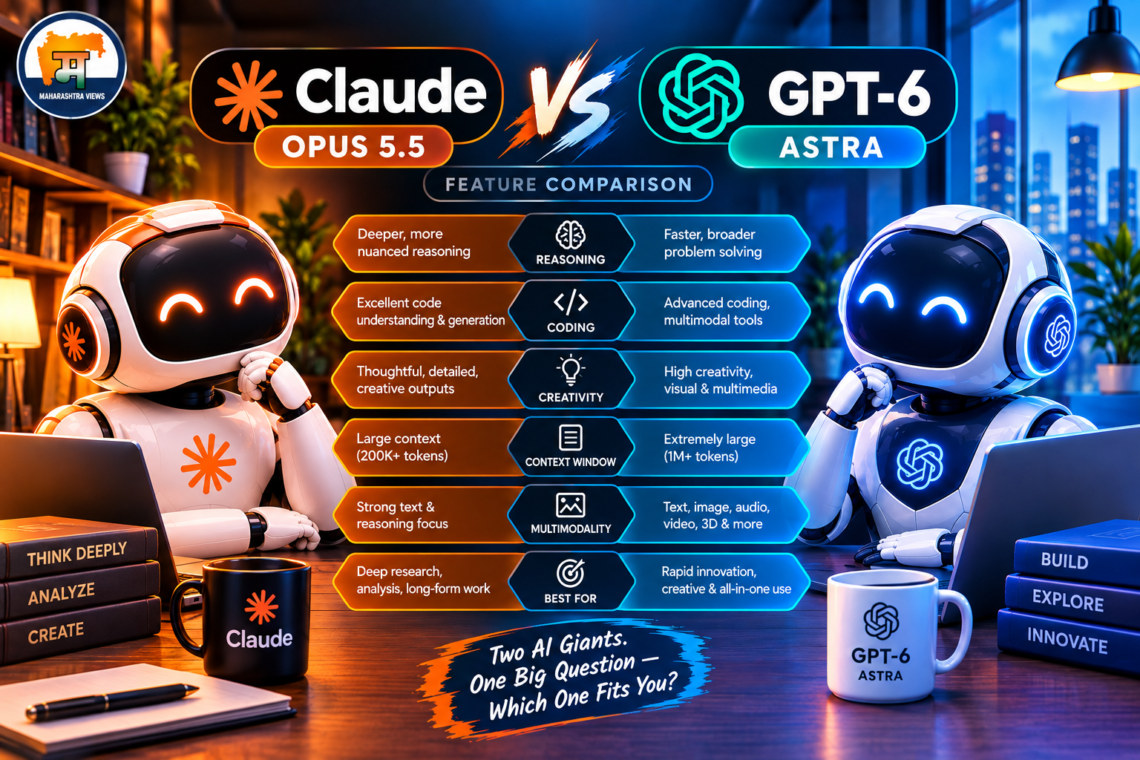
First, let’s look at the basics. The table below gives you the big picture.
| Feature | Claude Opus 5.5 | GPT-6 Astra |
| Launch | Around September 22, 2026 | September 3, 2026 |
| API price (per million tokens) | $4 input / $20 output | $10 input / $50 output |
| Context window | About 1 million tokens | About 1.05 million tokens |
| Writing tone | Warm and human | Clean and direct |
| Word-count control | Often writes too long | Sticks to the target |
| Best known for | Design, video, coding agents | Business work, computer use, math |
Prices and scores come from public reports and vendor claims. They can change, so check the official pages before you buy.
Opus 5.5 vs Astra in Writing: Which Sounds More Human?
Writers will care about this part most. Community testers on r/WritingWithAI found a clear difference. Opus 5.5 sounds warm and natural, like a friendly person talking to you.
Astra feels colder. On the other hand, that makes it great for short business writing.
Both models have flaws. Opus 5.5 sometimes slips into run-on sentences and repeated “X to Y” phrases. Meanwhile, Astra repeats certain patterns too. Research shared with the ACLA suggests no model avoids this fully.
In one big test, a user fed both models over 10,000 pages of work documents. Each model wrote a report of 75 to 80 pages. The Claude report became the main draft. Even so, the tester borrowed a few sections from Astra because its formatting was cleaner.
Opus 5.5 vs Astra in Coding and Agent Work
Coding is where the fun happens. On Terminal-Bench 4.0, Anthropic puts Opus 5.5 at 66.4% against 57.9% for Astra. However, the companies themselves reported these stats, and they used different effort settings.
An independent run by Artificial Analysis tells a calmer story. Here, both models scored equally at 59.6%. So be careful with these massive gaps between the two.
Astra is better in some areas. It scores higher on Terminal-Bench-Science (64.6% vs 58.7%) and looks strong at computer use. OpenAI also reports a near-perfect 99.9% on ARC-AGI-3. In short, Astra seems better at science and app use.
Opus 5.5 vs Astra in Design and Video Editing: MindStudio’s Real Tests
Benchmarks only tell half the story. So let’s look at MindStudio’s 12-task comparison, which used the same prompts for both models.
Landing Page Design
Opus 5.5 built a dark, premium page. It had layered visuals, scroll animations, drop shadows, and a rotating FAQ section. That took 40 minutes and cost $18.32.
Astra built a lighter, brighter page. Its flavour-switching module felt truly custom. It also finished in 32 minutes for $11.33. Even so, testers gave the quality win to Opus 5.5.
Event Reel and Instagram Reel
Video editing is lopsided. The 30-second sizzle reel video from 105GB of raw material took 31 minutes with a cost of $10 in Opus 5.5.
Whereas Astra took 39 minutes and cost $21 to $22. Its sizzle reel started off slowly without any life in it. Similarly, its Instagram video was described as bland and vanilla, with a cost of only around $9.

Business Deliverables
This is where Astra demonstrated an intelligent approach. While creating an investment deck, financial sheet, dashboard and landing page, it stopped and asked some questions. This resulted in making the setup more customized.
But the final investment deck did not have any branding elements. The Google Sheet report contained just the simple SUM formula. Hence, it looked like a model and not a flagship one.
Opus 5.5 vs Astra in the 3ds Max Test: CAD, Revisions and a Chair
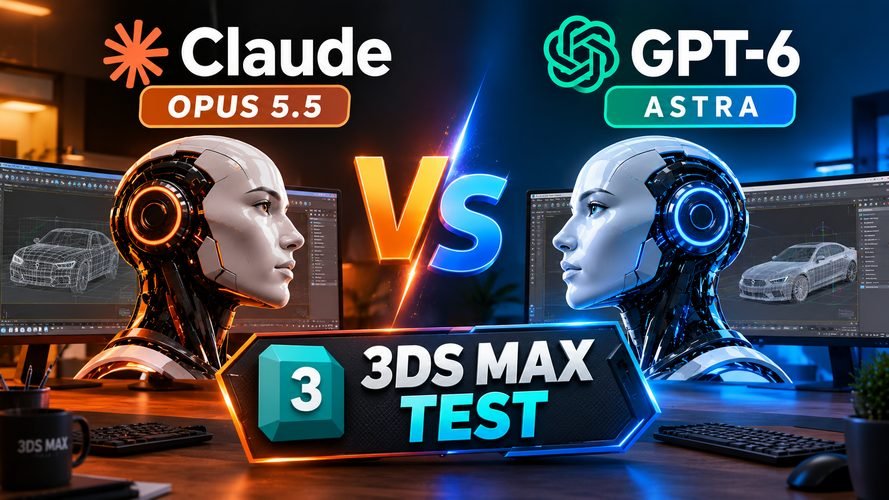
The YouTube channel Arch Viz Artist tested both models inside 3ds Max. They used the free Max Ultra MCP plugin. Astra ran through Codex, and Claude ran through Claude Code.
Here is how the main results looked:
| Test | Claude Opus 5.5 | GPT-6 Astra |
| CAD floor plan to 3D | 23 minutes, under 2,000 polygons | 40 minutes, about 5,000 polygons |
| Materials | Autodesk Physical Materials | Simple V-Ray materials |
| Client PDF revisions | Better sofa, curtain, and lamp finishes | Removed rug geometry correctly |
| Armchair from a URL | Boxy seat, accurate legs | Soft, rounded shape, clean mesh |
| Crash recovery | Restarted 3ds Max by itself | Did not crash |
Opus 5.5 was faster and handled shaders better. Astra, on the other hand, understood what the client really wanted. For example, it deleted the rug pattern geometry, while Claude only changed the texture.
The armchair test decided the winner. Astra captured the soft silhouette and added stitching details. Therefore, the channel named Astra the overall 3ds Max winner.
Opus 5.5 vs Astra Price: The Part Most People Get Wrong
On paper, Astra costs about 2.5 times more per token. Opus 5.5 charges $4 per million input tokens and $20 per million output tokens. Astra charges $10 and $50.
However, the final bill can surprise you. In the landing page test, Astra was cheaper because it finished faster. In the video test, though, it cost more than double. You can see the details in MindStudio’s API cost breakdown.
Anthropic also asserts that Opus 5.5 equals Astra on Terminal-Bench 4.0 at only 40% of the cost. This is a company claim, so remember it.
Want a deeper look at Astra alone? Read our earlier post: Is GPT-6 Astra Really Worth the Hype in 2026?
Opus 5.5 vs Astra: Which Model Is Better at What?
Here is a quick scan of where each model leads.
Choose Claude Opus 5.5 for:
- Warm, natural writing
- Beat-synced video editing
- Attractive web design
- Coding agents and terminal work
- Shader and material work in 3D
Choose GPT-6 Astra for:
- Short, clean business writing
- Exact word counts
- Clarifying questions during long tasks
- Clean 3D mesh and structural revisions
- Science, math, and computer use
Microsoft also highlights Astra’s ability to move between apps and finish multi-step tasks. You can read more in the Microsoft Foundry announcement.
Maharashtra Views AI Tech Expert: Our Opus 5.5 vs Astra Verdict
So, which one would we pick? For bloggers, content creators, and designers, we lean towards Claude Opus 5.5. Its writing sounds human, and it won most creative tests. It also looks cheaper in many real tasks.
That said, Astra is a strong pick for business teams. It follows instructions closely and asks smart questions. It also does better in science, math, and app-based work.
Still, neither model wins everywhere. The smartest move is to use both for different jobs. Also, remember that many scores here come from the companies themselves. Test both models on your own work before you pay for either.
Final Thoughts on Opus 5.5 vs Astra
The Claude Opus 5.5 vs GPT-6 Astra story is not about one model beating the other. Instead, it shows that the best AI depends on the job in front of you. One writes like a person, and the other works like a careful assistant.
Start with the task, not the brand name. That one habit will save you both time and money.


You May Also Like

AI Revolution or Bubble? Find Out the Truth

Is GPT-6 Astra Really Worth the Hype in 2026?