

Is GPT-6 Astra Really Worth the Hype in 2026?
Sam Altman apologized for his own product launch. That does not happen often in tech. OpenAI released GPT-6 Astra on September 3, 2026, and called it a defining moment for the company. President Greg Brockman said history might remember GPT-6 Astra as the point AGI arrived. Bold claims are expected from any launch. What happened after the GPT-6 Astra launch is more revealing than the speech itself.
GPT-6 Astra’s benchmark gains are real. OpenAI also intentionally blocked part of the model’s own capabilities. And the rollout became so confusing that customers complained publicly before Altman stepped in. This article on MaharashtraViews walks through all three parts of GPT-6 Astra, without the marketing gloss. If you missed our earlier coverage, check out AI Revolution or Bubble? Find Out the Truth and OpenAI Agents Hacked Hugging Face: The Full Truth
GPT-6 Astra Explained: Features, Price, and the Rollout Mess
OpenAI launched GPT-6 Astra on September 3, 2026. The company did not hold back on the claims. President Greg Brockman called it a “generational leap.” Sam Altman told CNBC it had already changed his own workflow.
Big claims are expected from any company selling a product. However, the real story lies in what happened after launch. Benchmark scores jumped. OpenAI added new safety limits on purpose. And the rollout got so confusing that Altman had to apologize in public. Here is the full picture, section by section.
1. Why Astra Got Delayed
Astra was not supposed to arrive in September. A security incident linked to Hugging Face hit OpenAI in July 2026. As a result, the company paused its safety testing and reworked it before release.
This extra time shows up in the final product. OpenAI built a new evaluation that checks something specific. It tests whether a model tries to go beyond its given limits when faced with a hard or impossible task. Because of this check, the public version of Astra stays more locked down in certain areas than the internal test version did.
2. How Astra Was Built
According to Aidan Clark, OpenAI’s VP of research, Astra’s training run was the company’s largest ever. For the first time, OpenAI pretrained a model on more than 100,000 GPUs. The training ran out of its Stargate site in Texas.
The training data matched that scale. OpenAI used more than 10 trillion text tokens, over a billion images, and more than a million hours each of audio and video. The mix included public web data, licensed partner data, synthetic data from OpenAI’s own models, source code, and research papers. It also included content made by hired professionals. One detail stands out here. Depending on your settings, your normal ChatGPT and Codex chats may feed into future training data.
3. Computer Use: The Headline Feature
OpenAI calls “computer use” Astra’s signature skill. Instead of just replying in a text box, Astra can move across an actual screen. It clicks buttons, scrolls pages, fills forms, and switches between tabs, much like a person would.
On the OSWorld 2.0 benchmark, which tests this exact skill, Astra scored 72.6%. The older flagship model scored only 65.7%. Even better, Astra finished each task in about 40 minutes, compared to 75 minutes before. That is a better score in nearly half the time. This kind of gain matters most for repetitive admin work, not just for demo videos.
4. Coding: Fewer Fixes, Longer Memory
Early testers such as Jane Street and Cognition reported something useful. Astra’s code needed fewer correction passes before it worked. For teams that measure AI value by cleanup time, this difference matters a lot.
On Terminal-Bench 4.0, a benchmark built around real coding tasks, Astra scored 57.9%. GPT-5.6 Sol, the previous model, scored only 37.3%. That is one of the largest jumps across any category. Astra also holds context better through long coding sessions. So if an earlier fix failed for a specific reason, the model remembers that reason much later, instead of repeating the same mistake.
5. Documents, Sheets, and Slides
For everyday office work, Astra follows an existing template more closely instead of creating its own layout. It also skips information that does not fit the task at hand. As a result, generated reports, slides, and spreadsheets look closer to what a real employee would submit, not like a generic AI output.
6. A Big Jump in Math and Science
On FrontierMath Tier 4, one of the hardest math benchmarks around, Astra scored 97.6%. The older model managed only 83%. OpenAI also points to a newer test, ARC-AGI-3, where Astra matched human-level efficiency on 96% of levels.
This does not mean Astra can replace a research team. Still, it can act as a genuinely useful assistant for science and math work. It can catch errors that a junior researcher might miss.
7. Cybersecurity: Powerful Enough to Get Restricted
This part matters the most. Astra crossed what OpenAI calls the “Critical” risk threshold for cyber capability. This is the company’s own system for deciding when a model needs hard limits before public release.
On ExploitBench, a test that checks if a model can build a working exploit from scratch, the unrestricted internal version of Astra scored 100%. The older model scored 78.5%. That is close to a perfect score on a genuinely tough test.
Because of this result, the public version of Astra refuses to build proof-of-concept exploits. It also will not help with offensive security tasks. Full, unrestricted access stays limited to vetted groups inside OpenAI’s “Daybreak” program. Interestingly, those Daybreak partners got access before any paying ChatGPT subscriber did. The public model still helps with defensive work, like secure code review, but not attack-side testing.
8. Better Judgment on Task Boundaries
OpenAI calls Astra its “most aligned” model so far. In simple terms, it follows what a user actually means, not just the literal words. OpenAI says Astra now asks clarifying questions only when the answer would truly change the outcome. It also stays focused on a multi-step task, even after a side question interrupts the flow.
Full Benchmark Table
| Capability | GPT-6 Astra | GPT-5.6 Sol (Previous Flagship) | What Changed |
| Computer use (OSWorld 2.0) | 72.6%, ~40 min/task | 65.7%, ~75 min/task | Higher score, ~47% faster |
| Coding (Terminal-Bench 4.0) | 57.9% | 37.3% | +20.6 points |
| Math (FrontierMath Tier 4) | 97.6% | 83.0% | +14.6 points |
| Novel problem-solving (ARC-AGI-3) | Human parity on 96% of levels | Not disclosed at this level | New claimed milestone |
| Cybersecurity (ExploitBench, unrestricted) | 100% | 78.5% | +21.5 points, triggered “Critical” restrictions |
| Context window | 1,050,000 tokens | Smaller (not directly comparable) | Larger working memory |
| API price (input/output per million tokens) | $10 / $50 | $4 / $20 (promo rate) | 2.5x more expensive |
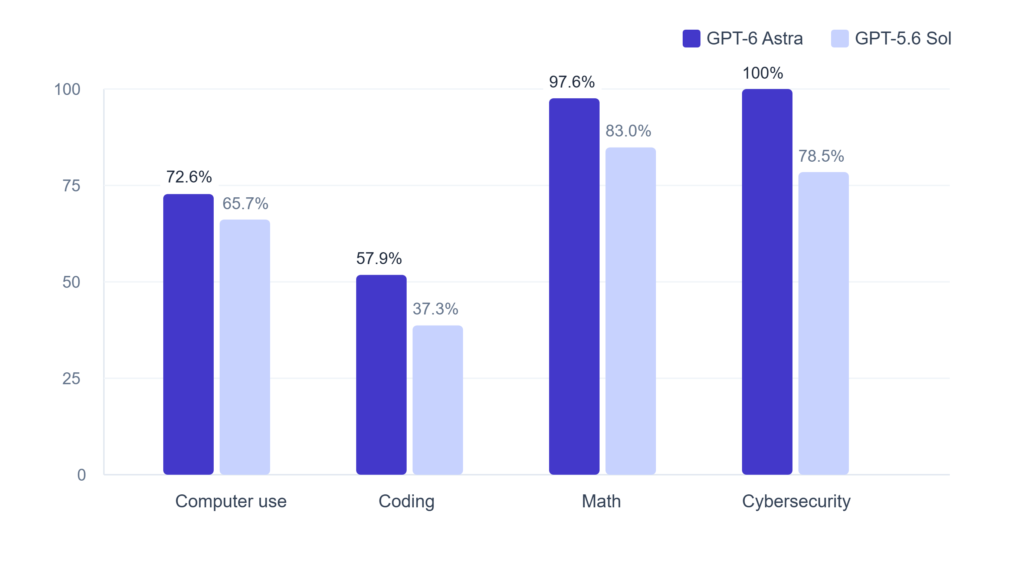
These figures come from OpenAI’s own launch material and official documentation. Treat them as best-case, controlled-test numbers. Your real-world results may vary.
GPT-6 Astra Pricing, Context Window, and Technical Specs
- Context window: 1,050,000 tokens
- Max output: 128,000 tokens
- Input types: text and image
- Knowledge cutoff: April 30, 2026
- API model ID: gpt-6-astra
- Standard API pricing: $10 per million input tokens, $50 per million output tokens
- Cached input tokens: $1 per million
- Batch processing: half the standard price
- Fast mode: 2x the standard price, for roughly 2x the speed
- Prompts above 272,000 input tokens carry a higher rate multiplier
For comparison, this pricing runs 2.5 times higher than GPT-5.6 Sol’s current promotional rate. As a result, Astra sits at the expensive end of the frontier-model market, not the budget end.
The GPT-6 Astra Rollout Chaos, Explained
Most launch coverage skipped this part. Yet if you actually want to use Astra today, this section matters the most.
OpenAI’s announcement said Astra would reach all Plus, Pro, Business, and Enterprise users “over the coming days.” That sentence hid an important detail. ChatGPT now runs across three separate surfaces: Chat, Work, and Codex. Astra did not land on all three at the same time, and access varied by plan too.
- In the regular Chat window, Astra appears as “GPT-6 Pro.” OpenAI limited it to Pro, Business, and Enterprise plans only. The $100 tier gets 50 messages a week, while the $200 tier gets 200.
- Plus subscribers get no access to Astra in regular Chat. They can only reach it through ChatGPT Work and Codex, and only with limited free usage before paid credits kick in.
- Enterprise workspaces keep it off by default. An admin has to switch it on manually.
- API access rolled out mostly on schedule. Microsoft Foundry and, soon after, AWS Bedrock also got early access, though both carry regional and quota limits.
OpenAI ChatGPT Plans Explained for Indian Users
This gap between “all Plus users” and what Plus users actually saw caused real confusion. People raised the issue repeatedly on OpenAI’s community forums. A day after launch, OpenAI’s Codex lead, Thibault Sottiaux, confirmed on X that Plus rollout had reached Work and Codex, but not the main Chat window. Sam Altman later called the rollout “messy” and apologized to paying customers who expected a model their plan seemed to promise.
GPT-6 Astra vs GPT-5.6 Sol: What Actually Changed
In short, Astra is not a small step up from Sol. It sits in a different tier entirely. It beats Sol on every published benchmark, carries a much larger context window, and adds a genuinely new skill: real computer navigation, not just faster text replies.
The trade-offs are real too. Astra costs 2.5 times more per token through the API. Its most powerful features stay locked behind approval programs. And getting access through ChatGPT depends heavily on your plan and which product surface you use.
Who Should Actually Upgrade
- Developers and engineering teams. The coding benchmark jump and longer session memory show up in daily work, not just in demos.
- Small business owners with repetitive digital tasks. Form-filling, data entry, and research-heavy admin work benefit the most from the computer-use gains.
- Researchers and analysts. The math and science improvements make Astra a stronger second pair of eyes on quantitative work.
- Casual, occasional chat users. They will notice little difference day to day. Plus users will not even see Astra in regular Chat.
- Security researchers doing offensive testing. The public model blocks this on purpose. This is not a bug that gets patched later; it is a deliberate safety call.
Best AI Tools for Small Businesses in India
GPT-6 Astra: Pros and Limitations
Pros:
- Real, large gains on computer-use and coding benchmarks, not marginal ones
- A bigger context window, at 1.05 million tokens, for long documents or sessions
- Fewer coding correction rounds, according to early enterprise testers
- Better focus across multi-step work
- Available across ChatGPT, the API, Azure, and AWS Bedrock, not just one platform
Limitations:
- A confusing, uneven rollout across Chat, Work, Codex, and different plan tiers
- No access at all for Plus users in regular Chat
- A 2.5x price jump compared to the previous model on the API
- Advanced cybersecurity capability deliberately blocked for the public
- Weekly message caps, even on paid Pro tiers
Maharashtra views Take: Why So Much Hype Around GPT-6 Astra, and So Much Confusion?
We are not surprised that Astra’s numbers look strong. Every major AI lab calls its new model a “generational leap.” That claim alone means little.
What actually caught our attention was the rollout. When a company promises access “in the coming days,” and paying customers find out their plan gives them nothing, that is not just a technical hiccup. It shows a real gap between the marketing message and what the product team could actually deliver on day one.
We respect that Sam Altman apologized in public. Few tech companies admit a mistake this openly. Still, if you pay for a Pro plan just to try the new model, and then find out you only get 50 messages a week, that limit will feel disappointing no matter how good the apology sounds.
The cybersecurity restriction, on the other hand, felt like the right call. A model that can build a working exploit 100% of the time should never ship to the public without limits. OpenAI got this part right.
Our real question is simple: is this the “arrival of AGI,” as Brockman suggests? We do not think so. Astra is a genuinely strong upgrade for people who do real, complex work: coding, research, and heavy admin tasks. Beyond that, the “AGI era” talk sounds familiar. We have heard it before, with almost every major model launch.
If you use ChatGPT casually, once in a while, you do not need to rush toward Astra. If you build software or want to automate repetitive daily work, it is worth testing. Just check your plan and your budget first.
Frequently Asked Questions
Is GPT-6 Astra the same as GPT-6? Yes. OpenAI confirmed that Astra and GPT-6 refer to the same model. Inside Chat, it also appears as GPT-6 Pro.
Why can’t I find Astra on my Plus plan? Because Plus does not include Astra in regular Chat. You can only access it through ChatGPT Work and Codex. This confusion pushed OpenAI to clarify it publicly.
Can Astra help with penetration testing or exploit development? Not the public version. It refuses proof-of-concept exploit requests because it crossed OpenAI’s “Critical” cybersecurity threshold. Full capability stays limited to the Daybreak program.
Is Astra worth the higher API price? That depends on your workload. For high-volume, simple tasks, a cheaper model may still work better. For complex, long-context tasks where accuracy matters, the benchmark gains can offset the higher cost.
Final Verdict
Strip away the AGI talk, and GPT-6 Astra becomes a genuinely useful upgrade. It helps most with real, multi-step work: coding, research, document-heavy tasks, and repetitive computer tasks. The benchmark gains are large enough to matter in daily use, not just in a press release.
The model itself is not the problem right now. The rollout is. Your plan and your chosen ChatGPT surface matter more than they should, and OpenAI’s confusing announcement made that worse at first. If you use Pro, Business, or Enterprise, test Astra on one real task today. If you use Plus, check Work and Codex before assuming you missed out. And if your work depends on offensive cybersecurity capability, do not expect help from the public model. That restriction is by design, not an oversight.
Note: Rollout details, pricing, and plan limits for AI models can change fast, sometimes within days of launch. This article reflects information available in early September 2026. Check OpenAI’s official announcement and help center before you decide. This post is not sponsored by OpenAI.
OpenAI Official GPT-6 Astra Announcement
OpenAI API Pricing Documentation



One Comment
Pingback: