UPI New Rules 2026: MDR Charges and What You Should Know
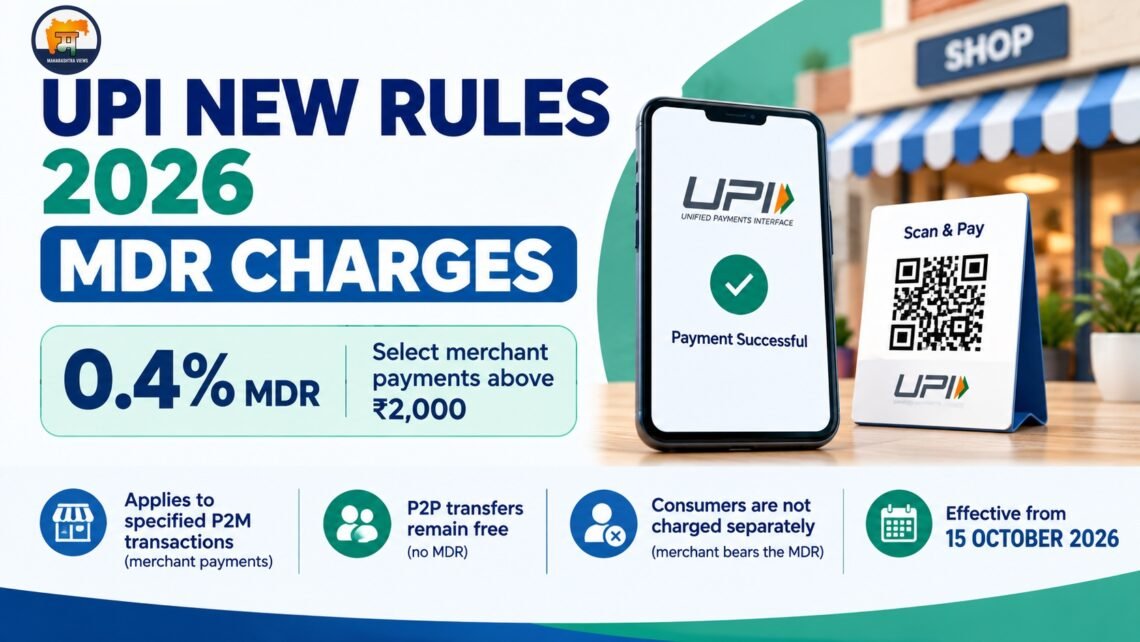
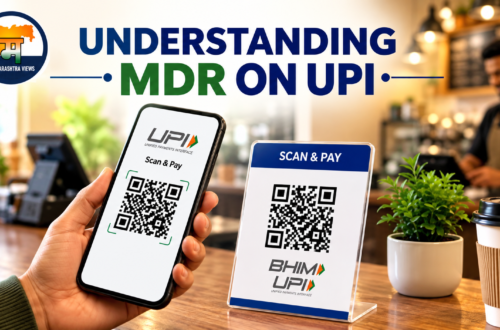
Will UPI become chargeable? That is the question everyone is asking right now. The short answer is no, not for you. The UPI new rules 2026 come into effect on 15 October 2026, but the new charges apply only to merchants.
We have explained everything about the UPI new rules 2026 in simple words. You will learn who pays, how much they pay, and what to do if a shopkeeper asks you for an additional amount. For more finance updates, visit MaharashtraViews.com.
What Are the UPI New Rules 2026?
The new MDR framework starts on 15 October 2026. MDR stands for Merchant Discount Rate. The Department of Financial Services (under the Ministry of Finance) and NPCI designed it. Its aim is to cover the cost of running UPI, such as servers, payment processing, and cybersecurity.
Merchants pay this fee, not customers. It applies only to eligible merchant payments above ₹2,000.
Here are the key points of the UPI new rules 2026:
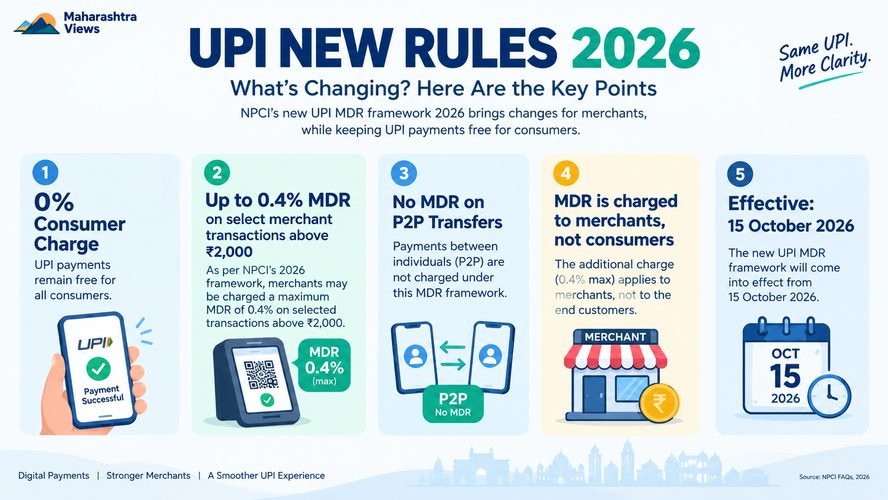
- The new rules start on 15 October 2026.
- UPI stays completely free for regular users.
- Payments up to ₹2,000 have zero MDR.
- More than 95% of merchant UPI payments fall in this free group.
So most of your daily payments will not change. In fact, tea, small grocery bills, auto fares, and mobile recharges usually stay under ₹2,000.
UPI New Rules 2026: P2P vs P2M Payments
Before we go further, you need to know two terms. UPI payments are of two types: P2P and P2M.
| Type | Meaning | MDR |
| P2P (Person-to-Person) | Sending money to family or friends, or splitting a restaurant bill | ₹0, always free |
| P2M (Person-to-Merchant) | Paying a shop or business for goods and services | Only in eligible categories, above ₹2,000 |
P2P transfers cost nothing. In addition, there is no monthly limit on free transfers. For example, you can send ₹500 or even ₹1,00,000, and the fee stays zero.
Meanwhile, many people think ₹2,000 is the most you can pay on UPI. However, that is not true. In fact, it is only the point at which a merchant starts paying MDR. So, it is not a spending limit.
UPI New Rules 2026 MDR Fee Structure Explained
The fee under the UPI new rules 2026 is easy to understand. Up to ₹2,000, the merchant pays nothing. Above ₹2,000, the standard rate is 0.4% of the payment. However, once a payment reaches ₹75,000 or more, the fee stops growing and stays at ₹300.
| Payment Amount | MDR Rate | Merchant Pays |
| Up to ₹2,000 | 0% | ₹0 |
| ₹3,000 | 0.4% | ₹12 |
| ₹5,000 | 0.4% | ₹20 |
| ₹10,000 | 0.4% | ₹40 |
| ₹50,000 | 0.4% | ₹200 |
| ₹75,000 | 0.4% | ₹300 (cap reached) |
| ₹1,00,000 | Capped | ₹300 (instead of ₹400) |
If you like pictures more than tables, this chart shows the same thing:
MDR paid by merchant (₹)
₹3,000 ▌ 12
₹5,000 ▌▌ 20
₹10,000 ▌▌▌▌ 40
₹50,000 ▌▌▌▌▌▌▌▌▌▌▌▌▌▌▌▌▌▌▌▌ 200
₹75,000 ▌▌▌▌▌▌▌▌▌▌▌▌▌▌▌▌▌▌▌▌▌▌▌▌▌▌▌▌▌▌ 300
₹1,00,000 ▌▌▌▌▌▌▌▌▌▌▌▌▌▌▌▌▌▌▌▌▌▌▌▌▌▌▌▌▌▌ 300 (capped)
The cap helps sellers of costly items. A merchant who sells a ₹1 lakh item pays the same ₹300 as one who sells a ₹75,000 item.

Special MDR Rates for Key Sectors
Not every payment above ₹2,000 gets the 0.4% fee. Some groups get a lower rate or no fee at all.
- Small merchants (P2PM): Small shops and street vendors who receive up to ₹1 lakh a month on UPI QR codes still pay zero MDR.
- Railways, telecom, insurance, fuel and agricultural inputs: These pay a flat ₹5 per payment above ₹2,000.
- Capital markets: Payments to SEBI-regulated entities pay 0.02%, with a ₹300 cap. This covers mutual fund investments, broker wallet top-ups, and share purchases.
- UPI AutoPay: No MDR is fixed for recurring payments.
Here is an example under the UPI new rules 2026. A ₹5,000 payment at a regular store costs the merchant ₹20. The same ₹5,000 at a fuel pump costs only ₹5. And a ₹50,000 mutual fund payment costs just ₹10.
Do you own a small shop? Then read our earlier blog, UPI New Rules 2026: What Small Business Owners Need to Know. For official updates, you can also visit the NPCI website.
Consumer Rights Under UPI New Rules 2026
The UPI new rules 2026 protect customers clearly. Three points matter:
- You pay no extra fee. If your bill is ₹3,000, you pay ₹3,000.
- Shops cannot add a surcharge. Banks and guidelines tell merchants not to pass the MDR on to you.
- Apps cannot add hidden charges. UPI apps are not allowed to charge platform fees to users.
Still, some shopkeepers may ask for extra money. If that happens, follow these steps:
- Save proof. Keep the payment screenshot, transaction ID (RRN), merchant details, and the receipt.
- Raise a dispute. Complain through your UPI app or your bank.
- Call the National Consumer Helpline (NCH). The numbers are 1915 and 1800114000. You can also send a message to 8800001915 by WhatsApp or SMS. Or use the NCH website or the Umang app.

Why Did NPCI Bring the UPI New Rules 2026?
Why did NPCI bring these changes? Because UPI has become really big. In August 2026 alone, it handled about 2,451 crore transactions worth nearly ₹29.9 lakh crore.
Running something this large is not cheap. For one, it needs strong technology and tight security. It also has to stay up all day, and people need support when a payment fails.
That is why the UPI new rules 2026 ask merchants to pay a small share on bigger payments. Besides, this money does not leave the payments system. It goes into server security and helps payment service providers. A part of it also goes to a special fund, which helps small shops start taking digital payments.
What Merchants Should Do Before 15 October
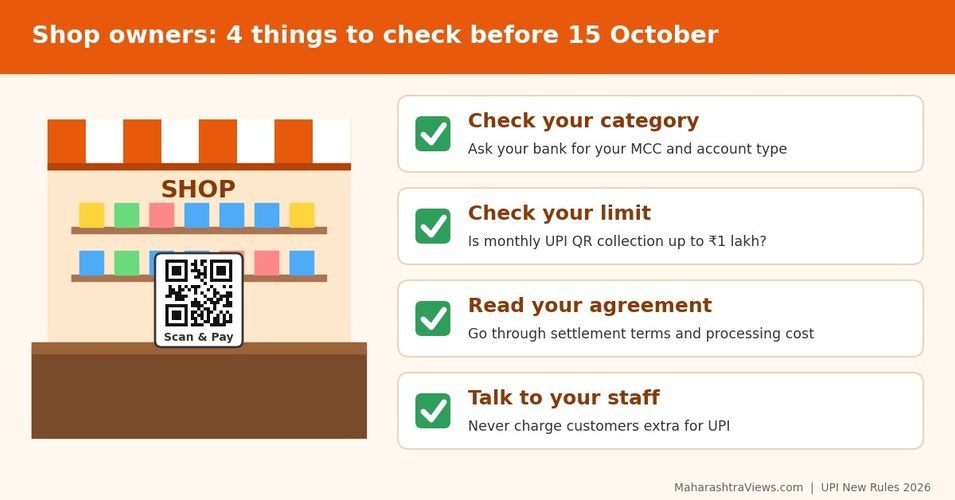
If you run a business, do these four things before the UPI new rules 2026 begin on 15 October:
- Check your category. Ask your bank for your Merchant Category Code (MCC) and account type.
- Check your limit. See if the money you get through UPI QR codes stays up to ₹1 lakh a month. That decides your zero-MDR status as a small merchant.
- Read your agreement. Go through your settlement terms and be ready for the processing cost.
- Talk to your staff. Tell your billing team never to charge customers extra for using UPI.
MaharashtraViews Opinion on UPI New Rules
As per us, the UPI new rules 2026 are balanced on paper. More than 95% of merchant transactions are exempt from MDR charges, and small merchants can continue enjoying zero MDR. The owner of the tea shop and the student of the college are both safe.
However, we have observed that ronkdsv issue may rolzc. Shopkeepers might prefer cash for all transactions that are more than ₹2,000. Others might try adding some extra amounts in the transaction bill. This is not acceptable, and customers should not accept it.
From our side, the important thing is how banks and payment applications make this change clear to everyone. Early awareness of the UPI new rules 2026 will prevent arguments at the counter of the shop.
Final Thoughts
But the news regarding the UPI new rules 2026 is scary indeed! However, the changes are very minor. You continue to transfer money to friends for free. You continue to pay the exact amount at the billing counter. The change will affect only the merchants, and that too on larger amounts.
So remain calm and pay nothing extra! Keep in mind the ₹2,000 limit, keep a copy of your transaction, and use the helpline if required. Stay tuned for more easy finance updates at MaharashtraViews.com.
Disclaimer: The blog is intended to provide general information only. Regulations, charges, and categories are liable to change. It is advisable to refer to NPCI and the bank for further official details before making any business decisions.


You May Also Like
UPI New Rules 2026: What Small Business Owners Need to Know

Infosys Share Crash: 7 Facts You Need to Know