Badrinath Dham: The Complete Guide You Actually Need
Badrinath Dham: The Complete Guide to India’s Most Sacred Himalayan Temple 🙏🏔️
This temple, Badrinath, is located 3,133 metres above sea level, nestled amidst two mountain ranges named Nar and Narayan. Indeed, just one fact gives you plenty of information about the place even without going there. This is not a temple situated in a bustling town; this is a temple that is co-located with the raw nature of the Himalayas.
This place is one of the four Char Dhams of India. Moreover, this temple is also a part of the Chota Char Dham of Uttarakhand. Thus, one single town is quite important from a religious point of view due to dual reasons.
Are you looking for detailed and practical travel guides? Maharashtraviews.com is what you need.
The passage below will provide all the information you need to know about the history, the legends, temple secrets, how to travel there, the budget, where to stay, and what places nearby are worth visiting.
Why Badrinath Dham Matters So Much 🕉️
Badrinath is Lord Vishnu’s territory. The very name tells you about it – “Badri” is the jujube tree, “Nath” is lord. Hence, “Lord of the Badri tree.” But there’s more to this name. There’s an interesting reason for it. Goddess Lakshmi is believed to have transformed herself into a Badri tree to protect Vishnu from the heat of the sun during his meditation. And thus, the name came.
This temple lies on the banks of the River Alaknanda. The surrounding terrain is mountainous. Mountains surround it from all directions.
The History Behind the BadrinathTemple 📜
The history of Badrinath didn’t occur all at once. It has developed gradually over several centuries.
Adi Shankaracharya Found the Idol
Adi Shankara took the Black Stone idol of Lord Vishnu from the Alaknanda River in the 8th century. Such idols are known as Shaligrams. He placed this idol inside a cave near Tapt Kund. That place later became the temple that exists to this day.
It was not just any discovery, but also part of a larger plan by Shankara. The four pilgrimage centers established by him across the country included Badrinath. This gave the temple national significance.
A Mahabharata Connection Most People Don’t Know
Yet another connection of Badrinath comes from the Mahabharata. The natives say that the Pandavas went through this very place and the adjacent village of Mana as they made their way to heaven. This route has been named Swargarohini.
Thus, walking through Mana actually means walking through an episode from one of the ancient Indian epics. Not all temple towns can make such a claim.
More Than Just a Hindu Site
What surprises many people is that the Badrinath site holds significance for Jains as well. There are several monks in Jainism who attained Moksha after years of penance at this site. Therefore, the site is not just about one particular religion but many religions.
“Kedarnath Dham: Untold Secrets That Will Amaze You”
Temple Architecture and Hidden Details of Badrinath Dham 🏛️
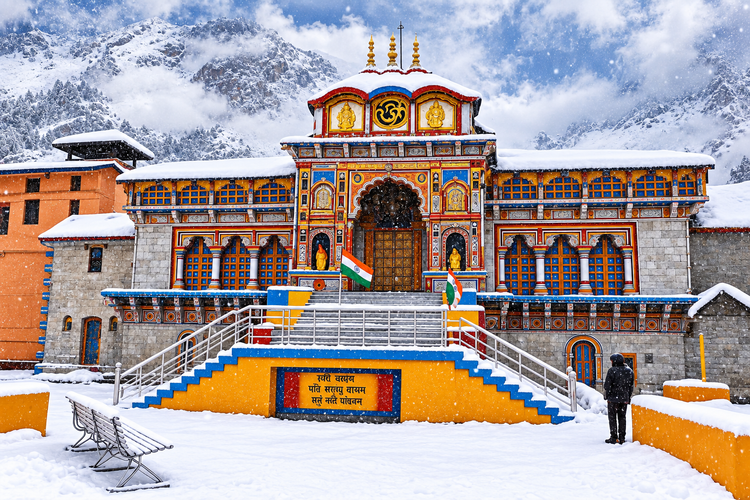
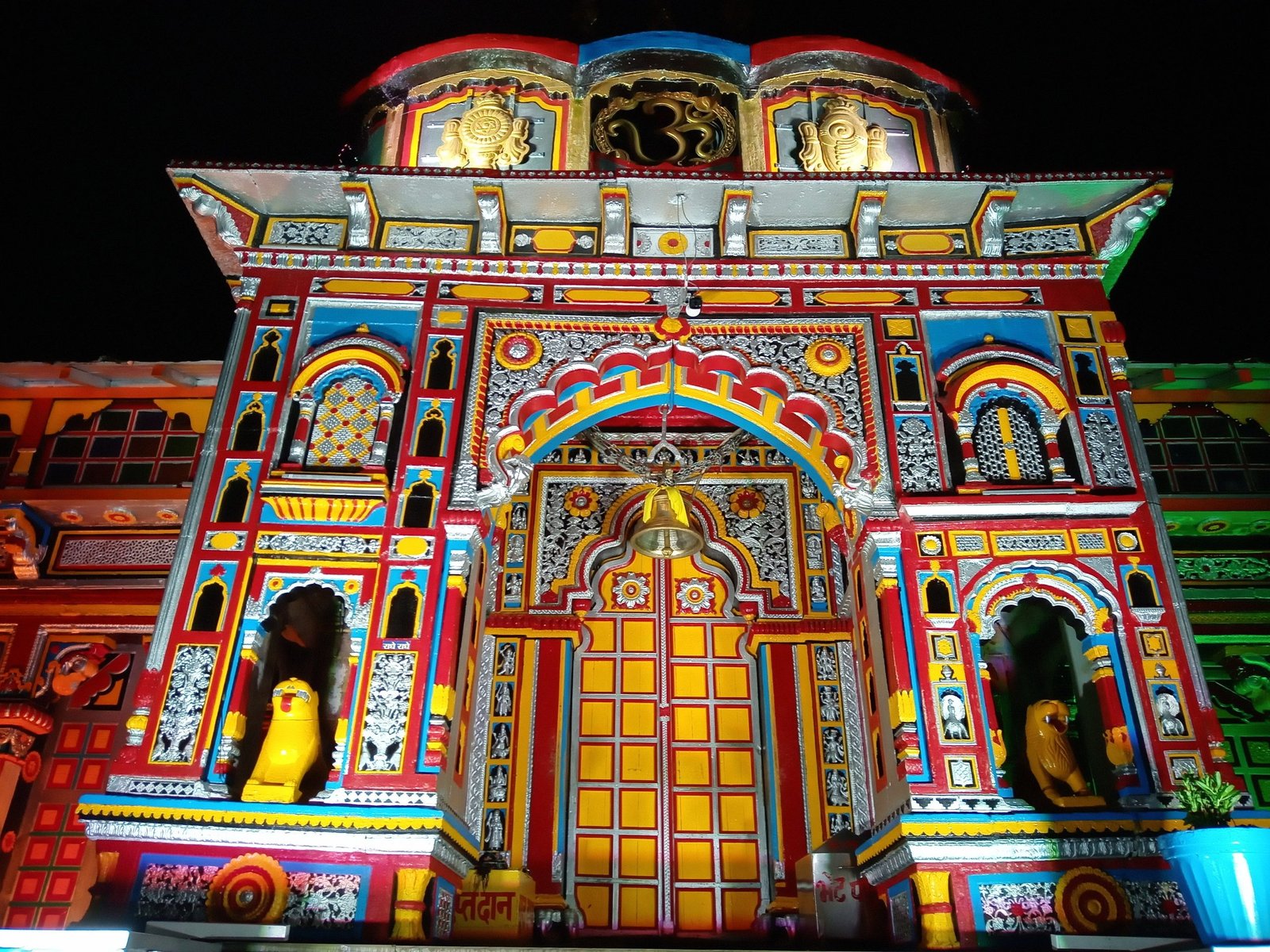
The temple is different from other temples in North India in the sense that its front looks like a Buddhist Vihara with a cone and a roof of gold.
The temple is almost 50 feet high and consists of three sections:
- Singh Dwar – the main entrance
- Mandap – the assembly hall
- Garbhagraha – the inner sanctum, where the deity sits
The Idol at the Centre of It All
Inside, you’ll find a 3.25-foot Shaligram idol of Vishnu, seated in Padmasana — the lotus position. For devotees, this is considered one of the most powerful forms of Vishnu anywhere in the country.
That Golden Shine Isn’t as Old as You’d Think
Here’s a detail most people skip past. Back in October 2005, a devotee from Mumbai donated gold to replace the temple’s older silver gates and throne. So that gleam you see in photos? It’s a fairly recent addition, not something ancient.
Priests From the South, Running a Temple in the North
One more point of interest — the head priests of Badrinath, known as Rawals, belong to the Nambudiri Brahmin sect of South India by tradition. For generations, this tradition has continued, despite the temple being located way up in the northern Himalayas.
What Visitors Actually Feel at Badrinath Dham 🌡️
The weather is the first thing that surprises everyone. No one thinks that it will change this abruptly.
It is cool in the mornings, even in June – somewhere in the region of 5°C to 15°C before sunrise. Then comes the sunshine, and within no time people begin to take off their jackets. By night, it becomes cold again.
Most newcomers prepare themselves for either one or the other extreme, but not both. Hence, it is a regular practice among them to buy a few shawls or jackets from the local stores.
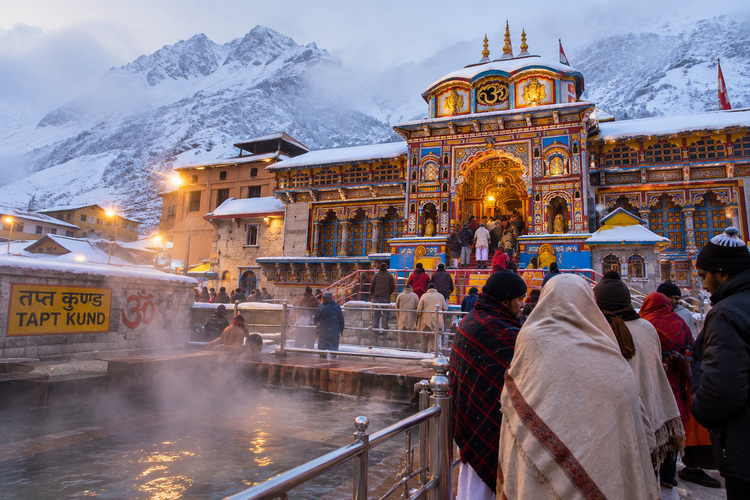
There is altitude as well. Some visitors may feel short of breath or get a little headache on their first day. Nothing to be concerned about, as that generally disappears after acclimatization. It would do no harm to walk slower and pause rather than run around on your first day.
It is in the evening when the charm of this place starts working its magic. The mountains turn dark early, bells at the temples ring, and this strange silence spreads all over. Most visitors would tell you what they remember from their journey, and that would be this moment.
What Pilgrims From Maharashtra Say 🧡
If one speaks to a number of Maharashtrian pilgrims about their experience, one thing that is bound to come out very often is that the cold is an unwelcome surprise.
Since this is a place that belongs to a warmer state, one is definitely not going to be prepared for the sudden onset of Himalayan cold, especially from a place like Maharashtra, where it can be quite warm at times.
Best Time to Visit Badrinath Dham 🗓️
The temple isn’t open year-round. Snow simply makes the region unreachable in winter.
| Season | Months | What to Expect |
| Peak Season | May – June | Heavy crowds, pleasant weather |
| Monsoon | July – September | Fewer pilgrims, landslide risk |
| Closing Rush | October – November | Crowds return before winter shutdown |
| Closed | December – April | Temple shut due to snow |
Usually, the temple starts operations in late April and closes in November. It should be noted that due to the Hindu calendar, these days may change every year a little bit, so make sure you check everything beforehand.
One thing that is always remembered – there is a light that is always burning inside the temple throughout the whole period when it is closed. This light is known as Divya Jyoti and it is not looked after at all.
How to Reach Badrinath 🚗
Most pilgrims start from Haridwar, roughly 313 km away.
- By Road: 10–12 hours, through Rishikesh, Devprayag, Srinagar, Rudraprayag, and Joshimath
- By Helicopter: Runs from Sahastradhara near Dehradun, same-day return, around ₹80,000 per person (this can change, so verify before booking)
- By Bus: Regular buses from Haridwar cost roughly ₹700–₹800 one way
The road itself goes through several small hill towns, and the truth is, this part becomes an integral part of the trip. It is not just the journey from point A to point B; it is all about the history that you go through.
Before you leave, it’s worth checking the “Uttarakhand Tourism Official Website” for route and weather updates.
Budget Guide: What Will It Actually Cost You? 💰
Costs swing a lot depending on how you travel.
- Standard Budget: Around ₹17,500 per person for 3 nights, 4 days — private car, decent hotels
- Low Budget / Solo: Around ₹6,500 per person, using regular buses, staying in dharamshalas
- Hotel Range: ₹1,500 to ₹4,000 a night, depending on things like electric blankets
Travelling solo or watching your budget closely? Dharamshalas near the temple save you both time and money.
Where to Stay 🏨
Make sure that whatever accommodation you find is within 1 km of the temple. This is a very important consideration.
Why? Simply because morning temperatures at Badrinath are chilly, and nobody would want to cover such distances at this temperature. In addition, you won’t have to worry about long lines for Darshan.
- Look for electric blankets during the colder months
- Book early if you’re going in May-June — rooms fill up fast
- Dharamshalas work well for solo or budget travellers
Sacred Spots Near the Badrinath Temple 🌊
Tapt Kund
The hot springs are located just outside the temple premises, with the temperature of the water lying somewhere between 40 to 50 degrees Celsius. Most pilgrims take a dip in this water before proceeding to Darshan because it purifies you.
Brahma Kapal
Right on the banks of the Alaknanda, this spot is used for Pind Daan — rituals performed for ancestors. Plenty of families travel here specifically for this reason alone.
Mana Village: India’s “Last” Village 🏘️
Just 4 km from Badrinath, you’ll hit Mana — often called India’s first or last village, depending on which direction you’re coming from.
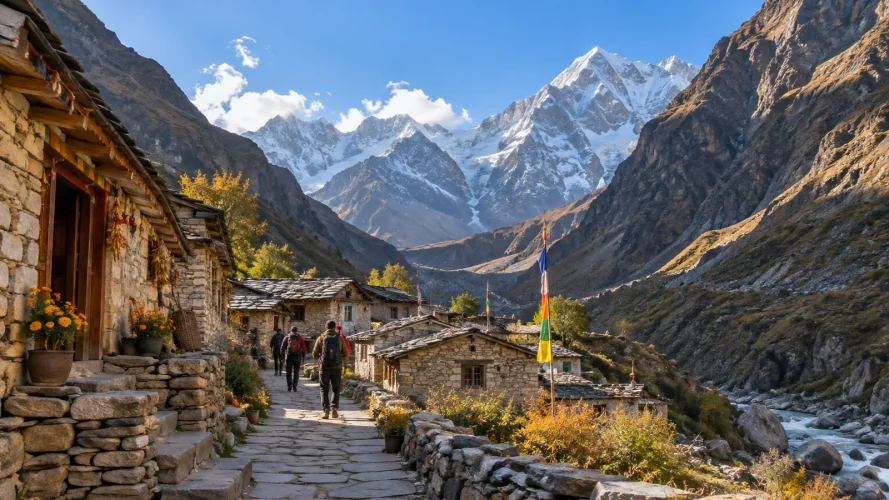
A few spots here are worth slowing down for:
- Vyas Gufa – where Sage Ved Vyas is believed to have written the Mahabharata
- Bhim Pul – a massive natural rock bridge over the Saraswati River, said to have been placed by Bhima himself
- Vasudhara Falls – a scenic waterfall a short trek away, a favourite among photographers
Here’s a fact that many tourists overlook. The Saraswati River disappears into the rocks immediately after Bhim Pul. Locals call this spot Patal Lok; they believe that the river goes underground into the other world and then rejoins the Alaknanda. It may or may not be true, but seeing a river disappear directly into the rocks is indeed an odd experience.
For more verified background on these sites, the “Archaeological Survey of India” is a solid reference point.
Practical Tips Before You Go ✅
- Pack layers, even in summer. Weather flips fast at this altitude.
- Go for Darshan in the evening. Queues are noticeably shorter than in the mornings.
- Keep cash on hand — ATMs get unreliable once you’re deep into the mountains.
- Start early in the day. Roads get trickier after dark, especially in landslide-prone patches.
- Carry basic medicines for altitude discomfort, just in case. Pack layers, even in summer. Weather flips fast at this altitude.
- Go for Darshan in the evening. Queues are noticeably shorter than in the mornings.
- Keep cash on hand — ATMs get unreliable once you’re deep into the mountains.
- Start early in the day. Roads get trickier after dark, especially in landslide-prone patches.
- Carry basic medicines for altitude discomfort, just in case.
Planning more than one Dham on this trip? “Char Dham Yatra Complete Travel Guide” breaks down the routes in more detail.
Things to Carry: Quick Checklist 🎒
| Category | Item | Why It Matters |
| Clothing | Thermal layers + jacket | Mornings and nights get cold, even in summer |
| Clothing | Comfortable walking shoes | Uneven paths near temple and Mana village |
| Health | Basic medicines (fever, altitude discomfort) | Medical shops are limited in remote stretches |
| Money | Cash in small denominations | ATMs are unreliable beyond Joshimath |
| Documents | ID proof, printed hotel bookings | Needed at checkpoints and for entry |
| Essentials | Torch / power bank | Power cuts are common in hill towns |
| Comfort | Woolen cap, gloves, socks | Wind near Tapt Kund and temple courtyard is sharp |
Keep this list somewhere handy while packing. Forget even one item, and you’ll probably end up paying extra for it at some roadside shop.
MaharashtraViews Take 🧡
Badrinath is not a travel destination that you should tick off your bucket list.
Crowds, cold, and the long drive make your experience hard while you’re going through it. But that’s the point! The trip was never meant to be comfortable, and that’s precisely why it sticks with you.
If you plan to visit Badrinath, take it slow. Spend one extra day if you can, preferably at Mana village. In 90% of cases, people regret rushing through Badrinath, but rarely regret spending an extra day there.
That’s our sincere opinion. No matter where you’re headed and what you’re searching for – tranquility, religion or a respite from monotony, we hope Badrinath gives it all to you! 🙏
Final Thought
No one ever intended Badrinath to be an expedition to rush through. The temple itself appears to be tiny when compared to its surroundings, and it is precisely this aspect that gives it an added appeal. While you are there for its religious significance, it will be the chilling mornings, the sound of the stream, and the feeling of insignificance in front of the huge mountains that leave an indelible impression on you.
Plan your trip dates carefully, dress warmly, and don’t forget to visit Mana village. This is generally what tourists take home with them.
Check out maharashtraviews.com for more such factual and research-based travel guide articles. 🧭


You May Also Like
Devgiri Fort: The 8 Wonder of The World
Sinhagad Fort: Ultimate Guide to Pune’s Famous Fort