Is the iPhone Duo Worth It? Apple’s First Foldable, Reviewed
iPhone Duo: Apple Finally Folds the iPhone, and Nothing Feels the Same

There has been little to no change in the iPhone’s appearance over the years. The most surprising change was the introduction of the notch back in 2017. Another change came on September 9, 2026, when Apple announced its “Surprise and Shine” event in Cupertino, California. The highlight of the event was the launch of the iPhone Duo, Apple’s first-ever foldable phone.
If you follow Apple launches with us at the MaharashtraViews homepage: “MaharashtraViews Tech , you know our style. We don’t just repeat a press release. We break it down properly. So let’s get into what actually happened, what it costs, and who should buy it.
A New Face on Stage: John Ternus Takes Charge
This time, Tim Cook did not present it because John Ternus delivered the keynote. He became Apple’s new CEO on September 1, 2026, and Tim Cook has moved into the role of executive chairman of Apple’s board.
This was Ternus’s first keynote as CEO, and he chose to start with one of the riskiest products Apple has ever launched. One thing that did not change is that everything got better: better chips, better cameras, and better Siri.
iPhone 18 Pro and Pro Max: More Chip, Sharper Camera
Here’s the corrected paragraph:
The display sizes remain the same. You will see the 6.3-inch Pro and 6.9-inch Pro Max. Therefore, there are no major changes in terms of a redesign. Apple paid attention to improvements on the inside. The new A20 Pro chipset is used in both versions. It is based on a 2nm architecture. This new chipset is equipped with a 6-core CPU, a 7-core GPU that comes with Neural Accelerators, and a 32-core Neural Engine (a dual 16-core design). According to Apple, the GPU performance increased by 40% in comparison with the A19 Pro.
iPhone 18 Pro / Pro Max at a glance:
- Display: 6.3 inches (Pro) and 6.9 inches (Pro Max) – both known sizes
- Chipset: A20 Pro with a 2nm architecture having a 6-core CPU, 7-core GPU with Neural Accelerators, and a dual 16-core (32-core) Neural Engine
- GPU: 40 percent faster compared to A19 Pro
- Camera: 48 MP Fusion Main camera with variable aperture, 48 MP Fusion Ultra Wide, and 48 MP Fusion Telephoto
- Battery: up to 36 hours (Pro) / 43 hours (Pro Max) for video playback
- Price in India: ₹1,64,900 (Pro) / ₹1,79,900 (Pro Max), 256GB base, up to 2TB
The Camera Finally Lets You Control Light
Here’s the broader picture for photography enthusiasts. The 48MP Fusion Main Camera uses a mechanical variable aperture system. This is the first time that this technology has been integrated into an iPhone. The six blades can open up and close down into four preset apertures — f/1.48, f/1.8, f/2.8, and f/4.0. These allow users to control the Depth of Field like a professional camera user.
There are two additional cameras as well. 48MP Fusion Ultra Wide-Angle and 48MP Fusion Telephoto Camera complete the package. The telephoto camera provides 4X optical zoom at 100 mm and 8X optical-quality zoom at 200 mm. There are also Pro Controls available in the camera to provide control over shutter speed and white balance settings, along with an on-screen histogram function. This shows that the company has kept professional photographers in mind when it comes to this camera.
The iPhone 18 Pro line has one other interesting feature as well. There is a photo authentication feature that tells whether the photo has been edited by AI technology.
Battery, Cooling and What It Costs
The thermal module receives a larger vapor chamber this year. It will help with extended gaming hours. Battery life is enhanced too. The iPhone 18 Pro can now last up to 34 hours of video playback. The Pro Max takes it even further to 43 hours. It is the longest battery life in an iPhone ever.
The base 256GB version of the iPhone 18 Pro starts at ₹1,64,900 in India. As for the Pro Max model, it starts at ₹1,79,900. Pre-orders started on September 12. Sales commenced on September 18.
iPhone Duo: Apple’s First Foldable, and It’s Genuinely Different

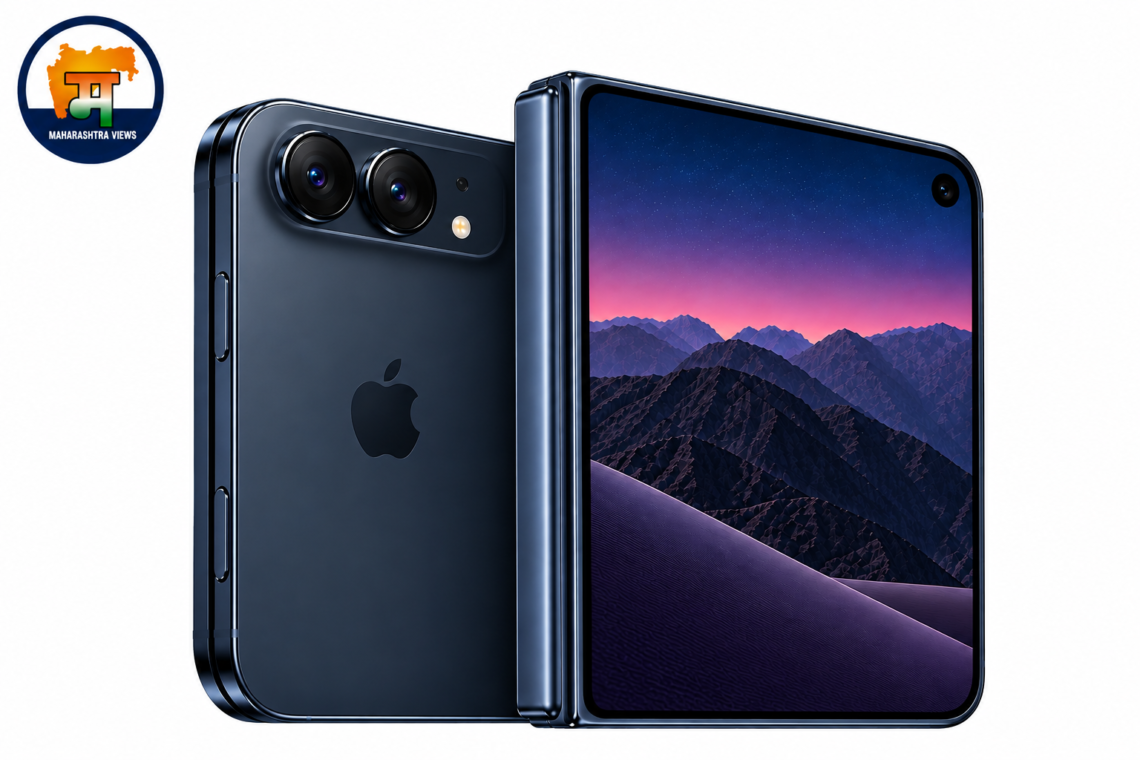
Here’s your headline, and it definitely deserves its place. The iPhone Duo unfolds just like a book would. When closed, it has an external display of 5.4 inches in size. When unfolded, there’s just one big screen with the size of 7.6 inches. Both displays have ProMotion. Both displays reach a brightness of 3,000 nits outdoors.
iPhone Duo at a glance:
- Outer display: 5.4-inch, ProMotion, 3,000 nits peak
- Inner display: 7.6-inch continuous fold-out, ProMotion, 3,000 nits peak
- Build: machined titanium, Ceramic Shield 2 (front), Ceramic Shield (back), IP68-rated
- Hinge: custom-built, 100+ precision parts
- Unlock: Touch ID in the side button, or paired Apple Watch (no Face ID)
- Camera: dual system (Main + Ultra-Wide), no telephoto lens
- Connectivity: eSIM only, no physical SIM tray, via Apple’s C2 modem
- Battery: up to 31 hours of video playback on the inner screen
- Colours: Star White, Night Sky
- Price: starts at $1,999 (US, 256GB); India pricing unconfirmed
iPhone Duo Design and the Hinge That Took Years to Get Right
This entire setup depends on a hinge with more than 100 precision-machined parts inside it, and this is precisely where Apple has probably put most of its engineering budget. This is what does all the work, ensuring that the panel remains absolutely flat when opened and folds without stressing the display during use. The hinge is enclosed in a milled titanium case and is accompanied by Ceramic Shield 2 on the front and regular Ceramic Shield on the back. With this additional IP68 rating, it certainly appears to be much more solidly built than the first-generation foldable smartphones from other companies that came out a few years ago.
Another notable claim made by Apple is that this device is the thinnest iPhone ever created — at least in the unfolded state. It is definitely a major engineering feat, considering that the device includes both front and rear screens, as well as the hinge. There is, however, one trade-off: the iPhone does not support Face ID. Instead, users can unlock the device either with Touch ID embedded in the side button or with the help of an Apple Watch.
The iPhone Duo Crease Question, Answered Honestly
Every foldable phone faces this question sooner or later. Apple hasn’t dodged it either. The company uses a nano-texture finish on the display. Custom adhesives help relieve stress in the screen layers. Together, these reduce how visible the crease looks. Apple never claims the crease is fully gone, though. Some visible or tactile line remains common on foldables. Only real, hands-on use will tell us how well this holds up over time.
Battery, Connectivity, and the Trade-offs
The dual batteries offer up to 31 hours of video on the inner screen. That’s solid for a foldable this thin. There’s no SIM tray on the Duo. That space now holds a bigger battery instead, adding roughly two extra hours of playback. eSIM handles connectivity here, through Apple’s own C2 modem. Note that there’s no telephoto lens either. The camera system is trimmed compared to the Pro Max. Keep that in mind if zoom photography matters to you.
Pricing starts at $1,999 in the US for the 256GB model. It climbs toward $3,199 for the top storage option. Apple hasn’t confirmed India pricing yet. Duo pre-orders only open on October 16, with availability from October 23. Early estimates suggest a price well above ₹2 lakh once import duty and GST are added. That number isn’t official yet, though. Treat it as a guess, not a fact.
| Storage | US Price | India Price |
| 256GB | $1,999 | Not confirmed (est. above ₹2 lakh) |
| 512GB | Not confirmed | Not confirmed |
| 1TB | Not confirmed | Not confirmed |
| 2TB | $3,199 | Not confirmed |
Note: Only the 256GB and top-tier prices have been officially shared by Apple so far; middle storage tiers and all India pricing will be updated once confirmed.
Siri Finally Gets Intelligence That Feels Useful
iOS 27 launches on September 14th. The software contains the most extensive Siri upgrade in years, powered by Apple Intelligence. Siri can now read everything on your display, fetch information from various apps, and even analyze camera feed in real-time through the new Visual Intelligence features. This means Siri can scan your flight confirmation email and build a packing list, factoring in the weather at your destination, without you having to ask for it step by step.
What makes this stand out is how the processing works. Simple requests are handled directly on your device, while more demanding tasks are routed through Apple’s Private Cloud Compute. Apple says that even for these cloud-processed requests, your data isn’t stored or shared with anyone — including Apple itself — and outside experts can verify this claim independently. This is a meaningful privacy distinction, since most cloud-based AI assistants can’t offer the same level of verifiable protection.
Apple Watch Series 12, Ultra 4 and AirPods 5: The Quiet Updates
Apple refreshed its wearables too, at the same event. These updates are far less dramatic than the Duo, though. The Apple Watch Series 12 and Watch Ultra 4 both move to a faster processor generation. Both keep their focus on background health tracking. AirPods 5 get an updated chip too, aimed at better audio processing and steadier connections. Apple hasn’t shared every detail publicly yet. We’ll cover this properly once full specs get confirmed. That’s a promise, not a placeholder.
MaharashtraViews Tech Desk Take: Is the iPhone Duo Actually Worth It?
Time for our honest take, ekdum straight. The iPhone Duo is genuinely ambitious. The titanium build, the slim profile, that custom hinge — it all sounds kadak on paper. But it costs roughly double the iPhone 18 Pro Max. This isn’t a phone for everyone. It was never meant to be.
| Feature | iPhone 18 Pro Max | iPhone Duo |
| Display | 6.9-inch, fixed | 5.4-inch outer / 7.6-inch inner, foldable |
| Chip | A20 Pro (2nm) | A20-series (foldable-optimised) |
| Camera | 48MP triple system, variable aperture, telephoto | Dual camera, no telephoto lens |
| Battery (video playback) | Up to 43 hours | Up to 31 hours (inner screen) |
| Unlock method | Face ID | Touch ID (side button) |
| Starting price (India) | ₹1,79,900 | Not officially confirmed; likely above ₹2 lakh |
If you shoot a lot of photos, especially with zoom, the 18 Pro Max is the smarter buy. It’s also the safer choice if you just want a refined iPhone with no real compromises. The Duo suits a narrower crowd. Think people who actually use a bigger screen for reading, multitasking, or Apple Pencil notes. They also need to be fine paying a premium for that flexibility, this early in the format’s life. Early adopters and creative folks will probably find it dhamaal to use every day. Everyone else can wait for the next generation, once prices settle and we get clearer answers on that crease.
For more on Apple’s AI direction versus its rivals, check our earlier piece here: Apple Intelligence vs Google Gemini: Who’s Actually Ahead in On-Device AI.
For Apple’s own spec pages and official statements, check Apple Newsroom — iPhone Duo Announcement and Apple India — Official iPhone 18 Pro Pricing Page
Quick takeaways:
- To begin with, Apple delivers an incremental but solid upgrade with the iPhone 18 Pro/Pro Max — new chip, variable-aperture camera, longest battery life yet
- In addition, Apple introduces its first foldable, the iPhone Duo, featuring a book-style design, a custom hinge, and a titanium build
- However, the Duo carries a few trade-offs: it drops Face ID, skips the telephoto lens, and removes the physical SIM
- Meanwhile, Apple hasn’t confirmed the Duo’s India price and launch date yet — it has only revealed US pricing and October pre-order dates so far
- Notably, new CEO John Ternus leads the keynote for the first time, while Apple rolls out a major Siri overhaul in iOS 27
Final Thoughts
What stands out most here isn’t a single spec sheet number or a price tag — it’s the timing. Apple chose its most transitional moment yet to take its biggest hardware risk in years. A new CEO stepping in, a decade-long foldable debate finally settled, and a Siri that actually does something useful — all of it landed together at once. Maybe the Duo goes on to become the iPhone’s next standard shape. Maybe it simply stays a pricey first step toward that future. Either way, one thing is clear: Apple has stopped waiting on the sidelines. And that, more than anything else, is what makes this year’s event worth remembering — long after the initial price-tag shock has faded.


You May Also Like
Vivo V80 Review: 7 Powerful Upgrades Worth Your Money

Is GPT-6 Astra Really Worth the Hype in 2026?